
Why Your Home Needs Sensory Boundaries in a Digital World
Modern life is designed for stimulation. Screens glow late into the night. Notifications fracture attention. Background noise rarely stops. The result is not simply distraction—it is chronic sensory overload. In this environment, the home should function as a counterbalance. Yet many living spaces mirror the digital chaos they are meant to escape. Without intentional design, there is no boundary between performance and rest. Creating sensory boundaries at home is no longer aesthetic preference. It is neurological necessity.
RUMI
2/19/20262 min read
What Are Sensory Boundaries?
Sensory boundaries are deliberate limits placed on visual, auditory, and olfactory input within a space. They reduce overstimulation and allow the nervous system to regulate naturally.
In a digital world dominated by:
Blue light exposure
Constant media consumption
Artificial noise
Rapid attention shifts
The brain rarely receives a clear signal to slow down.
When stimulation does not decrease, cortisol levels remain elevated, sleep quality declines, and attention becomes fragmented. Over time, this affects both mood and productivity.
Why the Home Should Signal Safety
From a biological perspective, humans are highly responsive to environmental cues. Light, scent, and sound all communicate whether a space is safe, stimulating, or threatening.
Warm lighting, muted sound, and grounded fragrance activate a parasympathetic response—the body’s “rest and digest” state. This lowers heart rate, steadies breathing, and reduces cognitive noise.
Without these cues, the brain stays in alert mode, even when there is no real danger.
Designing your home with sensory boundaries restores a missing signal: the day is over.
Light as the First Boundary
One of the most powerful sensory tools is lighting.
Bright overhead lights, especially LED lighting rich in blue wavelengths, mimic daytime conditions. They suppress melatonin and delay sleep cycles.
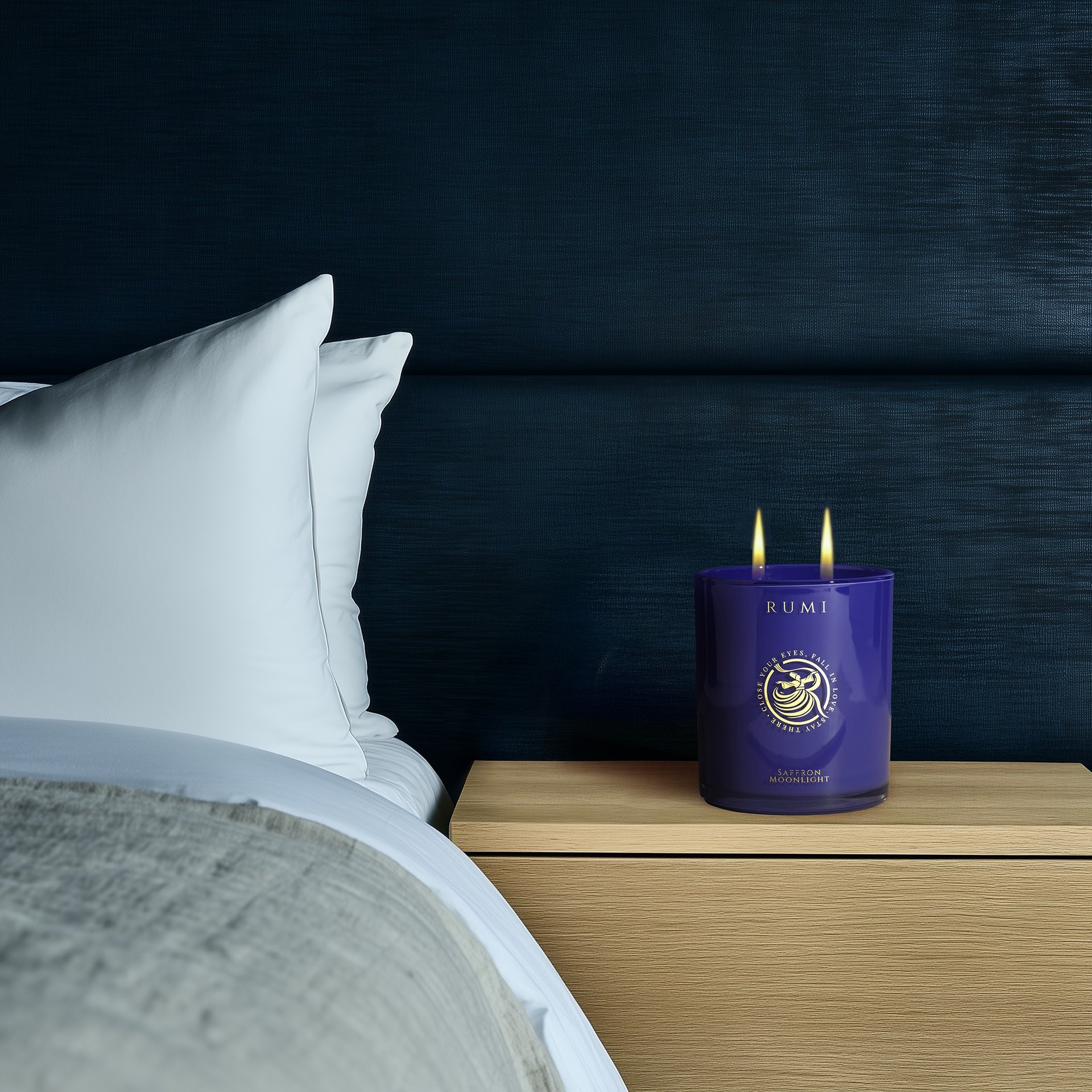
Candlelight operates differently. Its warm spectrum signals evening. Research on circadian rhythm and relaxation consistently shows that dim, warm light supports the body’s transition toward rest.
A simple shift—turning off overhead lighting and using candlelight instead—creates an immediate sensory boundary between work and recovery.
Scent as an Emotional Anchor
Fragrance reinforces this transition. Unlike visual input, scent travels directly to the limbic system, which governs memory and emotional regulation.
When a specific scent is used consistently in the evening, the brain begins to associate it with stillness. Over time, the body anticipates calm before the mind consciously registers it.
Grounded notes such as sandalwood, warm vanilla, and subtle spice tend to support this effect. Sharp or overly synthetic scents, by contrast, can increase cognitive load and sensory fatigue.
Scent should support presence—not compete with it.
The Role of Intentional Candle Rituals
A candle ritual is one of the simplest ways to establish sensory boundaries.
To implement:
Turn off screens 30 minutes before bed
Switch off overhead lighting
Light a candle at the same time each evening
Allow the scent and flame to mark the transition
Consistency is more important than duration. Repetition trains the nervous system.
Over time, lighting a candle becomes a neurological cue: performance mode is finished.
RUMI and the Design of Stillness
RUMI was founded with the belief that objects in the home should serve a purpose beyond decoration. In a culture saturated with stimulation, intentional design becomes essential.
Saffron Moonlight, RUMI’s signature scent, was developed specifically to support this evening boundary.
Its composition blends:
Saffron, for warmth and quiet depth
Vanilla, for softness without excess sweetness
Sandalwood, for grounding and emotional steadiness
The fragrance unfolds gradually rather than overpowering a room, allowing it to function as an anchor rather than a distraction. Each component is sourced from highly reputable fragrance manufacturers known for quality and consistency.
The intention is not to create more sensory noise—but to reduce it.
Why This Matters Now
Digital life is not slowing down. If anything, it is accelerating. Without deliberate sensory boundaries, the brain remains in a continuous cycle of stimulation.
Creating calm does not require renovation. It requires intention.
Sometimes the most effective boundary is small: a warm flame, a grounded scent, and a conscious pause.
If you are looking to establish a nightly ritual designed for stillness, Saffron Moonlight by RUMI offers a balanced, warm fragrance built specifically for that transition.
You can explore and purchase Saffron Moonlight directly through RUMI’s collection to begin building your own sensory boundary at home.