
The Evening Ritual: Why Lighting a Candle Signals the Brain to Slow Down
As daylight fades, the human brain looks for cues. Not notifications or screens, but signals that the pace of the day is changing. Long before artificial lighting, evenings were defined by firelight. That relationship between flame and rest remains deeply embedded in the nervous system. Lighting a candle may feel symbolic, but neuroscience suggests it is functional.
RUMI
2/9/20262 min read
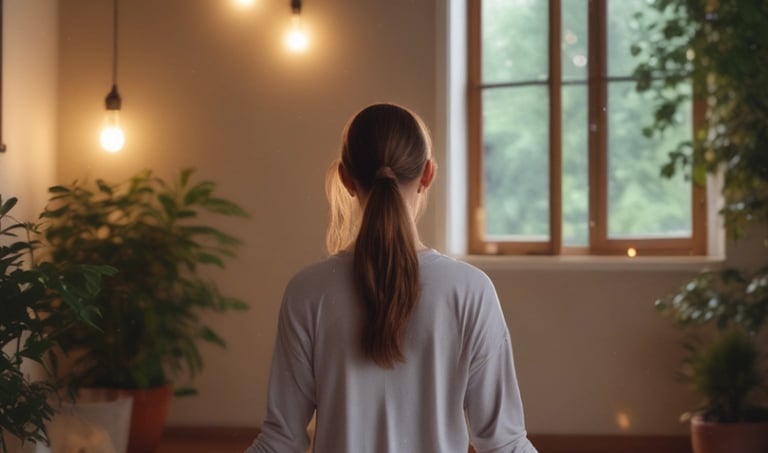
How Light Signals the Brain to Shift States
The brain depends on environmental signals to regulate circadian rhythm. Bright, overhead lighting—especially blue-spectrum light—stimulates alertness and suppresses melatonin, the hormone responsible for sleep readiness.
Candlelight operates differently. Its low, warm glow falls within a range the brain associates with safety, enclosure, and rest. Studies in chronobiology and environmental psychology show that dim, warm lighting can reduce cognitive arousal, slow breathing, and support the body’s transition out of performance mode.
This is why candlelight has historically been used in the evening—during meals, reflection, and rest—not as decoration, but as regulation.
Ritual as a Neurological Shortcut
Rituals work because the brain learns patterns faster than it learns language. When an action is repeated consistently—at the same time, in the same way—the nervous system begins to anticipate the state that follows.
Lighting a candle at the end of the day becomes a conditioned signal. Over time, the body responds before conscious thought does. Muscles relax. Attention narrows. The urgency of the day softens.
This is not mindfulness as abstraction. It is mindfulness as physiology.
Why Scent Strengthens Evening Rituals
Scent deepens this process. Unlike sight or sound, fragrance travels directly to the limbic system—the brain’s emotional and memory center—without being filtered through rational processing.
Evening-appropriate scents tend to share key characteristics:
Warm rather than sharp
Grounded rather than bright
Balanced rather than intense
When paired with candlelight, scent reinforces the same message: the day is ending.
Research into olfaction and mood consistently shows that restrained, well-balanced fragrances support emotional regulation, while overpowering scents increase cognitive load and sensory fatigue.
Saffron Moonlight: A Scent Designed for the Evening
At RUMI, scent is developed with this science in mind. Saffron Moonlight, the brand’s signature scent, was created specifically to support evening rituals rather than stimulate attention.
Its composition blends:
Saffron, offering warmth and subtle depth
Vanilla, adding softness without excess sweetness
Sandalwood, providing a grounding, steady base
The fragrance is intentionally layered to unfold gradually instead of filling a room all at once. This slow release allows the scent to support stillness without becoming intrusive.
All fragrance components are sourced from highly reputable manufacturers known for rigorous quality, consistency, and safety standards.
A Practice Rooted in Presence
RUMI was founded by actors Shad Modir and Emad Jafari, whose work depends on focus, emotional awareness, and the ability to transition deliberately between intensity and rest. That lived experience shapes how RUMI approaches scent—not as an accessory, but as a functional part of daily ritual.
For performers, the ability to disengage at the end of the day is essential. The same is true for anyone navigating modern life without clear stopping points.
How to Build a Simple Evening Candle Ritual
This does not require complexity.
A practical approach:
Turn off overhead lights
Light one candle at the same time each evening
Sit quietly for one minute before moving into nighttime routines
No affirmations. No performance. Just consistency.
Over time, the brain learns the cue.
Why This Matters Now
Modern life rarely provides natural endings. Work bleeds into night. Screens flatten time. Without intentional signals, the nervous system remains on alert long after the day is over.
Evening rituals restore boundaries. They tell the brain it is safe to slow down.
Sometimes, that signal is as simple as a flame.
Closing Thought
Stillness does not happen by accident. It is invited—often quietly.
Lighting a candle is not about atmosphere alone. It is about intention. And in a culture that rarely pauses, intention remains one of the most powerful tools we have.
For those who use scent as a way to mark the transition from movement to rest, Saffron Moonlight by RUMI was created with exactly that purpose in mind.